Guide
Firefighter Payslip Explained: Retainer, Overtime and Pension
Your firefighter payslip can change even when your basic salary or on-call retainer stays the same. The worked example follows a whole-time firefighter in England from an approved overtime claim to the amount that reaches the bank. If you work on call, the guide also shows how to reconcile your retainer, paid activity and call-outs against the records payroll used.
By Dan
Last checked
2026/27 PAYE and NI, July 2026 NJC pay, Firefighters’ Pension Scheme 2015 in England
Quick answer
Check basic pay or retainer against your role and duty system. Then match each overtime or call-out payment to an approved claim. Under England’s 2015 scheme, payroll sets your contribution rate using the actual pensionable pay for the firefighter job. Ask which pay figure set your rate and which earnings it applied that rate to this month.
Follow the figures on a sample payslip
Tap a number to see how payroll worked out that line and what to compare on your own slip.
Open the firefighter payslip exampleOn this page
Example 09
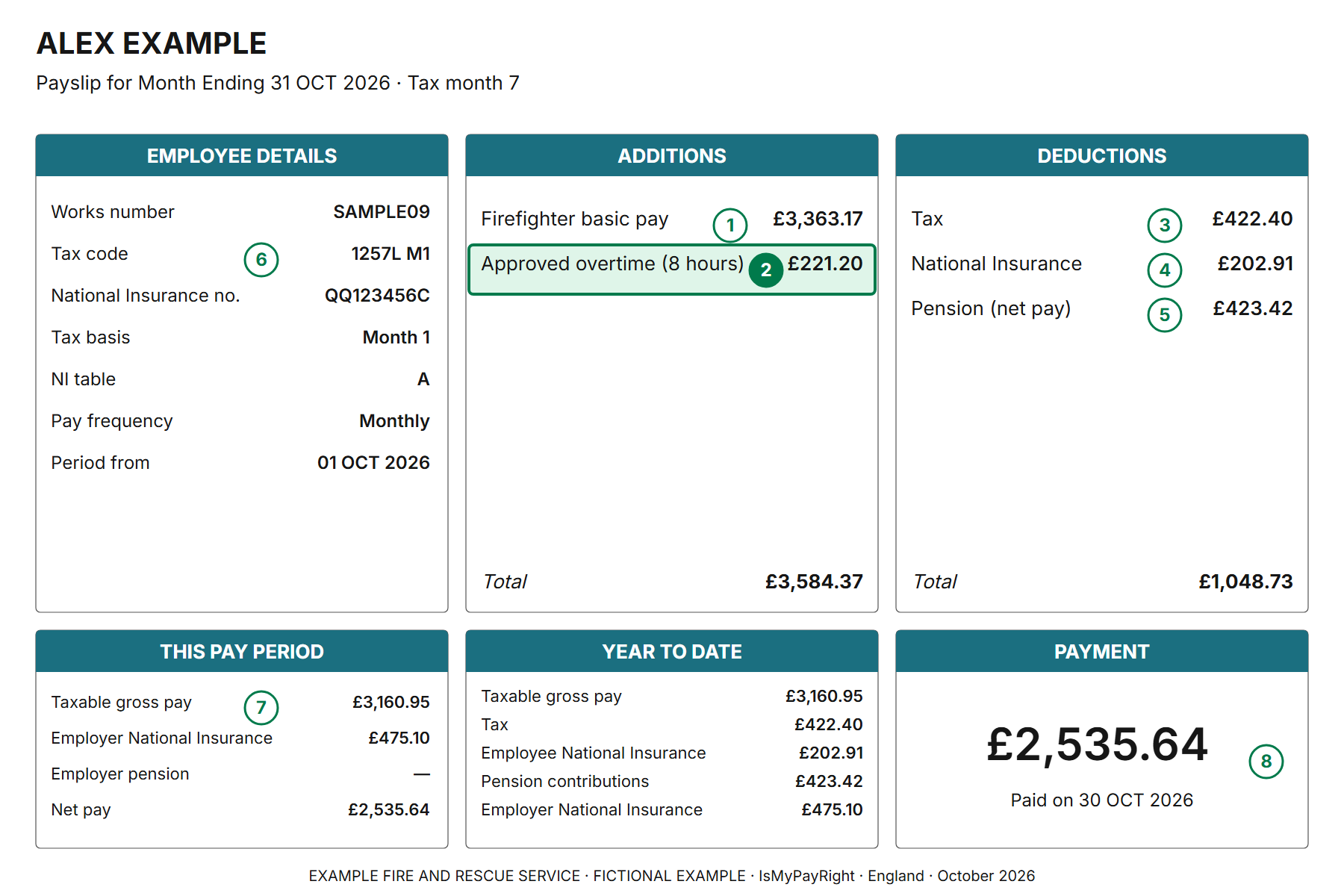
Firefighter payslip with overtime
Competent firefighter · England · October 2026
Fictional fire and rescue payroll specimen
Fictional employee and employer. An illustrative layout using common payroll headings. Your service’s labels may differ. Use the numbered explanation buttons, or enlarge the payslip to select a line on the document.
Line 2 of 8
Approved overtime
£221.20
Eight hours at the £27.65 published overtime rate add £221.20. The money counts towards gross pay, PAYE and NI in this run.
On your own payslip
Match the hours to the approved claim and ask which pay run picked them up.
Read all 8 explanations
1. Competent firefighter basic pay
£3,363.17
The £40,358 annual basic rate from July 2026 gives £3,363.17 for this full month after rounding.
Match your role, stage and effective date to your own pay notice.
2. Approved overtime
£221.20
Eight hours at the £27.65 published overtime rate add £221.20. The money counts towards gross pay, PAYE and NI in this run.
Match the hours to the approved claim and ask which pay run picked them up.
3. PAYE Income Tax
£422.40
M1 gives one month of free pay. Take £1,048.26 off £3,160.95 taxable pay, round down to £2,112 and apply 20%.
Check the code and tax basis as well as the taxable amount.
4. Employee National Insurance
£202.91
NI starts from the £3,584.37 gross including overtime. With category A, 8% applies above £1,048 in this monthly pay range.
Check the NI category and the pay subject to NI. The employer amount appears separately.
5. Firefighter pension deduction
£423.42 · 12.59%
Apply the confirmed rate to £3,363.17 in pensionable basic pay. This service treats the one-off overtime as non-pensionable in this example.
Ask payroll which annual figure set your rate and which earnings counted on this slip.
6. Tax code and basis
1257L M1
The M1 marker tells payroll to work out this payment on its own even though October is tax month 7.
If the marker is unexpected, ask which instruction payroll received and check your HMRC record.
7. Taxable pay before the allowance
£3,160.95
Gross is £3,584.37. The ordinary member pension deduction brings taxable pay down by £423.42 before payroll applies the tax code.
The same figure appears in this employment’s year-to-date box because it is the first payday here.
8. Net pay
£2,535.64
The pension, Income Tax and employee NI add up to £1,048.73 in deductions. Subtract that from £3,584.37 gross to get the bank payment.
If the payment differs, compare the dates and identify which earnings or deduction line changed.
Example assumptions, calculations and sources
Follow the money
From £3,584.37 to £2,535.64
Employee deductions account for the £1,048.73 difference. Employer contributions are paid separately and do not come off this take-home amount.
| Item | Amount |
|---|---|
| Gross pay | £3,584.37 |
| PAYE Income Tax | -£422.40 |
| Employee National Insurance | -£202.91 |
| Employee pension | -£423.42 |
| Net pay | £2,535.64 |
The example’s assumptions
- England taxpayer and competent whole-time firefighter on national NJC rates effective 1 July 2026. The annual basic rate is £40,358.
- The firefighter starts at this fictional service in October. This is their first full month with the service and includes eight approved overtime hours at £27.65 per hour.
- This service treats the one-off overtime in the example as non-pensionable. It has confirmed a 12.59% England 2015 scheme member rate on the basic pensionable pay.
- Payroll has a 1257L M1 instruction and uses the exact percentage method for monthly category A NI. Year-to-date figures are for this employment only.
- The example excludes local allowances, CPD, arrears, student loans and other deductions. Employer pension contributions are not shown.
See the calculation method
Monthly basic pay is £40,358 ÷ 12, rounded to £3,363.17. Eight overtime hours add £221.20, bringing gross pay to £3,584.37.
Pension is £3,363.17 × 12.59%, rounded to £423.42. Subtract it from gross to find £3,160.95 of taxable pay before the tax-code allowance.
The M1 free pay is £1,048.26. Subtract it from £3,160.95 and round the remainder down to £2,112 before applying 20%. PAYE is £422.40.
Employee NI is 8% of the £2,536.37 above the monthly £1,048 threshold, giving £202.91. Employer NI uses 15% above the separate £417 threshold, giving £475.10 after payroll rounding.
Subtract £423.42 in pension, £422.40 in PAYE and £202.91 in employee NI from £3,584.37. The bank payment is £2,535.64.
These are independently worked fictional illustrations using published rules and the stated contract assumptions. Actual payroll can depend on earlier pay, the employer’s settings and rounding method.
Sources for the layout and figures
- NJC July 2026 pay award
Local Government Association
Competent firefighter basic pay and overtime rates in Appendix A.
- Firefighters’ Pension Scheme 2015 contributions
Local Government Association
England pensionable earnings, member rate and tax relief.
- Work out an employee’s National Insurance contributions
HMRC
Independently confirms employee and employer NI on monthly category A pay of £3,584.37.
- Work out an employee’s Income Tax
HMRC
Confirms the PAYE on monthly taxable pay of £3,160.95 with code 1257L M1.
- Payroll technical specifications: Income Tax
HMRC
Version 24.0: weekly and monthly code allowances, non-cumulative tax and PAYE rounding.
- Rates and thresholds for employers 2026 to 2027
HMRC
Category A weekly and monthly employee and employer NI rates and thresholds.
- Employer further guide to PAYE and National Insurance contributions
HMRC
Net pay pension contributions reduce PAYE pay without reducing NI earnings.
Find the pay line that changed
Put the payslip beside the previous one and look at gross pay first. A whole-time firefighter normally has a regular basic-pay line. An on-call firefighter may see a retainer and several lines for work done. Some payroll systems combine payments or use local labels. If you have a single total for extras, ask for the attendance or claim breakdown before trying to match each entry.
Check the dates on the payslip, your pay or availability agreement, and the approved hours or call-outs. A claim worked in October may be paid in November. A move from development to competent has its own effective date. If a national award and a move in role both affect earlier pay, ask payroll to show each rate against the dates it covered. Use the backdated pay guide if you have a separate arrears line.
Check whole-time basic pay and overtime rates
For a regular full month, divide your annual basic rate by 12 as a starting check. First make sure you have the right scale. The July 2026 NJC pay circular has separate tables for firefighting roles, the retained duty system and fire control. These are the national rates for the two firefighter stages shown. Check your local agreement for any separate supplement or different arrangement.
| Firefighter stage | Annual basic pay | Published overtime rate |
|---|---|---|
| Development | £31,539 | £21.60 an hour |
| Competent | £40,358 | £27.65 an hour |
For a competent firefighter, £40,358 ÷ 12 comes to about £3,363.17 in basic pay for a full month. If eight approved hours are paid at the published £27.65 overtime rate, expect £221.20 gross on the payday that includes those hours. If the amount differs, ask how many hours were paid at which rate, and whether any hours are due in a later run. Keep any Continual Professional Development (CPD) payment or local allowance on a separate line while you reconcile the basic rate.
Work out your on-call pay and retainer
Start with the retainer. This is what your fire service pays you for agreed availability if you work on call, also known as the retained duty system. Check the commitment in your own contract before comparing it with a national table or a colleague’s payslip. Then check paid activity such as training, drills or time at incidents. Finally check any separate payment per qualifying call-out. The Essex fire service’s on-call guidance gives examples of the types of work that can generate activity pay.
Under the national Grey Book retainer bands, full cover means at least 120 hours of agreed availability per week. The full annual retainer is 15% of the basic pay for the equivalent whole-time role. The national bands below full cover are 12.5% for 91–119 hours, 10% for 61–90, 7.5% for 31–60 and 5% for up to 30 hours a week. Compare your own agreement with the relevant band, especially if your service has a local arrangement.
Here is a fictional month for a competent on-call firefighter paid the full NJC retainer in 12 instalments. Payroll has approved eight paid activity hours and four qualifying call-outs in this run. The figures come from Appendix B of the NJC circular.
| Payslip item | Calculation | Amount |
|---|---|---|
| Retainer | £6,054 ÷ 12 | £504.50 |
| Paid activity | 8 hours × £18.43 | £147.44 |
| Disturbance payments | 4 call-outs × £5.31 | £21.24 |
| Gross for the month | Add the three amounts | £673.18 |
One turnout can appear in both the activity and call-out records. One line pays for time worked and the other is a payment for the occasion, where the rules allow it. A drill can add paid time without adding a call-out. When the figures disagree, ask which attendance dates reached payroll before the cut-off and which items are still awaiting approval.
If firefighting is your second job, check the code for each employer in your HMRC account. HMRC can use different codes for the two employments. Our two-jobs calculator can help you see how the jobs fit together. For a particular fire service payday, start with the gross figure and the code on that slip, then check the pension and PAYE lines separately.
Check your firefighter pension deduction
First ask payroll which annual pensionable pay it used to set the rate. Since 1 April 2026, the England 2015 scheme uses actual pensionable pay for part-time and on-call firefighters. That means pay for your own job, even if the equivalent whole-time job has a higher salary. The scheme’s member guidance explains that the initial rate is set using the pay period that includes 1 April, or your annual pensionable pay when you join later in the scheme year. For monthly-paid members, the April check usually involves multiplying that month’s pensionable pay by 12. If a change in employment or a material pay change moves you into a new band, the scheme manager must tell you the new rate and when it applies.
Then find the pensionable amount for this payday. Payroll applies the rate for your band to the pensionable earnings on this run. In the 2015 scheme those earnings include an on-call firefighter’s retaining allowance and any CPD payment the authority has decided is pensionable. Temporary allowances and one-off overtime can increase gross pay while leaving pensionable pay unchanged. Ask which lines were included if you cannot get the pension figure by multiplying the rate by basic pay alone.
If you have both an on-call and a whole-time firefighter job, ask for the pension figures for each employment. England’s 2015 scheme sets the contribution rate separately for each job. National Insurance has separate rules. For example, a fire service that employs you in both jobs may have to combine the earnings for NI even though it works out pension contributions separately.
Worked example: firefighter take-home pay on £40,358
Suppose a competent whole-time firefighter in England earns at the £40,358 annual basic rate. Hold that rate constant for a full year, use 2026/27 tax rules, and assume payroll has confirmed a 12.59% member rate on pensionable basic pay. Assume the standard Personal Allowance, category A employee NI, and no student loan, overtime, allowances or other deductions. This illustration uses the July rate throughout, so it will differ from an actual year that includes earlier rates.
| Line | How it is worked out | Annual amount |
|---|---|---|
| Basic pay | July 2026 national annual rate | £40,358.00 |
| Member pension | £40,358 × 12.59% | £5,081.07 |
| Income Tax | 20% of pay after the pension and £12,570 allowance | £4,541.39 |
| Employee NI | 8% of £27,788 using annual thresholds | £2,223.04 |
| Take-home after these deductions | Gross less pension, tax and NI | £28,512.50 |
The monthly equivalent is £2,376.04, calculated by dividing the annual estimate by 12. The mock October payslip covers one payday with eight hours of overtime and a Month 1 tax code. The pension in both examples is taken before Income Tax is worked out. NI still starts from pay before the pension deduction and payroll applies the NI thresholds for the actual pay period. With a cumulative code, PAYE can also depend on earlier pay and tax. A bank payment can differ by more than rounding when the month includes arrears, a loan deduction or a change in tax code.
Give payroll something it can check
Send the pay date and the exact line you are querying. For an on-call shortfall, list the dates and approved hours or call-outs you believe are missing. For basic pay, give the confirmed stage and date it took effect. For a pension difference, ask for the annual pensionable figure used to set the rate, the rate applied and the pensionable earnings on this run. Those three figures let you see whether the query is about the band or the earnings included.
If gross pay reconciles but your take-home still looks wrong, compare this slip with the last one in the payslip comparison tool or check your payslip figures for the affected payday. If the tax code is the part you cannot explain, use the wrong tax code checklist and check the employment record with HMRC. Your pension administrator can explain scheme rules if you see a separate adjustment for an older firefighter pension scheme.
What to do next
- Match your role and stage to the pay notice in effect for the dates covered.
- For on-call pay, keep the retainer, paid activity hours and qualifying call-outs separate.
- Check whether any allowance or extra payment counted towards your pension.
- Compare two payslips with the approved attendance or duty records for the same dates.
- Ask payroll for the cut-off date and the pension calculation behind the changed line.
- If you have another job, check both employments and their PAYE codes in your HMRC account.
About this guide
Written by Dan. Dan has spent 20 years working across payroll, HR, benefits and reward. IsMyPayRight is an independent personal project, not connected with any employer or with HMRC.
AI tools help with research and drafting. The official sources used are listed at the end of the guide.
This is general guidance, not a professional review of your circumstances. Read our editorial process and the corrections log.
Methodology and sources
See how the calculations work, which sources they use, how results are tested, and which payroll details the estimates cannot verify.
Common questions
- Why is my retainer lower than the national full retainer?
- Check the weekly availability band in your agreement, plus the date it took effect. Ask payroll to show the annual retainer it used and how much of that was due on this payslip. If your agreed cover changed partway through the pay period, ask for the dates used to work out each part.
- Could sick leave change the pensionable pay on my firefighter payslip?
- Reduced or stopped pay can affect pension records. In some circumstances the England 2015 scheme uses what it calls assumed pensionable pay to protect pension build-up during an absence. Ask the administrator which pay figure it recorded and whether you need to take any action.
Official sources
Use these references to check the rules behind this guide. Check the tax year and your circumstances before applying an example to your own pay.
- NJC July 2026 pay award and retained rates
Local Government Association
- Grey Book retainer bands and full-cover hours
Local Government Association
- Firefighters’ Pension Scheme 2015 member contributions
Local Government Association
- England firefighters’ pension contribution regulations
legislation.gov.uk
- Essex on-call firefighter pay and attendance
Essex County Fire and Rescue Service
- 2026/27 PAYE and National Insurance rates and thresholds
HMRC
- Income Tax rates and the Personal Allowance
HMRC